Thursday, 29 September 2011

Wednesday, 28 September 2011
Creative Schorlaship to Japan
This is a creative scholarship opportunity that I am really interested in doing.
This programme aims to offer young and emerging professionals involved in the creative field and industry, an opportunity to take a residency programme in Japan to produce works and/or develop networks with their peers in Japan, in order to seek new forms of exchanges and foster mutual understanding. This programme is implemented as part of the Japan-East Asia Network of Exchange of Students and Youths (JENESYS) Programme.
Friday, 23 September 2011
Potential Post Grad Courses :
KINGS COLLEGE LONDON
Cultural & Creative Industries
PURPOSE
Provides a critical understanding of the cultural and creative industries for graduates seeking a career in the arts or creative industries or for professionals wishing to enhance their existing knowledge and career prospects. Can also prepare students for doctoral research in culture, media and creative industries. Please note that the programme does not cover media, marketing, advertising, public relations or journalism as separate disciplines, and does not provide vocational training in these areas. If you wish to follow a career in media, marketing, advertising or PR, MA CCI will only be relevant in so far as your interests relate specifically to the cultural and creative industries (e.g. film, music, visual and performing arts and cultural heritage). DESCRIPTION
This interdisciplinary programme allows students to examine the structure and history of the cultural and creative industries and explore practical and theoretical issues facing cultural entrepreneurs, professionals and policy-makers. It uses a range of analytical tools from sociology, history and cultural studies, and draws on teaching, research and professional expertise from both King's academics and professionals working in the field. Core modules look at cultural theory and history and the characteristics of cultural industries and creative organisations. Optional modules include Art of Management, Contextualising Creativity, The Creative City, "Creatives", Culture and Commerce, Cultural Markets, Cultural Policy, Film and American Culture, Internship in the cultural and creative industries, Subcultures, Visual Culture and two modules on the contemporary museum taught at Tate Modern. Students on the internship module undertake work experience in the arts or creative industries, and write a self-assessment looking at the skills, knowledge and motivation needed to build a career in these industries. Previous students have interned at the BBC, Film London and the V&A Museum. Finally, students research and write a supervised dissertation on chosen topic within the field.
Potential Post Grad Courses : KINGSTON
KINGSTON:
Kingston has a series of courses that are under ' the creative economy' course
Kingston University's unique new programme of postgraduate courses will inspire you to maximise your true potential across many areas of the Creative Economy.
After one intense year of full-time training or two years part-time, you will be equipped with the necessary practical skills and knowledge to succeed within your specialist creative discipline.
Communication Design & the Creative Economy MA
Part 1: core modules
- Design Thinking and Entrepreneurship in Practice
- Managing Creativity and Innovation
- Leadership in the Creative Economy
- Contemporary Issues in the Creative Economy
Part 2: specialist modules
- Design Group Projects
- Individual Design Projects
Part 3: personal project (choose one)
- Dissertation
- Innovative Project
Managing in the Creative Economy MA
Part 1: core modules
- Design Thinking and Entrepreneurship in Practice
- Managing Creativity and Innovation
- Leadership in the Creative Economy
- Contemporary Issues in the Creative Economy
Part 2: specialist modules
- Financial Resource Management
- Managing Operations
- Managing People and Organisations
- Marketing
Part 3: personal project (choose one)
- Dissertation
- Innovative Project
Design for Development MA
What will you study?
The Design for Development MA is about the need to change to a more sustainable and equitable society. The course content focuses on building a road-map to get there. You will be undertaking your studies in a number of faculties and schools across the University.
Socially and ecologically considered design urges:
- innovation;
- participatory design thinking;
- project and stakeholder identification;
- sustainable development models;
- entrepreneurship; and
- an anticipation of the consequences of communications, products and services.
This approach requires new knowledge, skills and collaborative partnerships.
We will examine ways to inspire and challenge organisations with positive, real-world solutions for a sustainable future through design interventions. It's about exploring innovative and practical ways to help realise those visions, emphasising design, innovation, entrepreneurship, leadership, communication and campaigning.
Please note that this is an indicative list of modules and is not intended as a definitive list. Those listed here may also be a mixture of core and optional modules.
Core modules
- Visioning a Sustainable World
- Entrepreneurship in Context
- Sustainable Design Principles, Perspectives and Practices
- Managing Corporate Social Responsibility and Sustainable Development
- Major Design Research Project
Option modules
- Biodiversity and Conservation
- Marketing
- Managing Creativity and Innovation
- Meaning and Protection of Human Rights
- Media, Public Policy and International Politics
- Sustainable Cities
- Sustainable Environmental Management
Potential Post Grad Courses : GOLDSMITHS
GOLDSMITHS
MA in Design & Environment
The MA in Design and Environment addresses the intersection of design and environmental issues from the perspectives of both theory and practice-based study. In distinction to other programmes in the area, the programme undertakes an intensive inquiry into environmental discourses and practices, and maintains that such an inquiry enables creative projects that would not be possible in other contexts. In this sense, the MA establishes a critical-creative setting in which you can challenge existing theory and practice and explore ways to expand your own research and practice.The MA helps you to:
- develop a systematic understanding of relationships and connections between design and environment, as informed by both theory and practice
- develop reflective abilities through exploring new practices and discourses in design and environment
- review methods and processes used in design and environment practice and research
- research, explore and extend understanding of sustainable practices and their social impact in design and related fields
- develop new approaches and skills to a high level to inform and develop practical and intellectual domains of professional work.
MA in Brand Development
What you study
The degree is made up of two core courses (60 credits in total), between two and four option courses (60 credits in total), and a dissertation (60 credits). Core courses introduce students to contemporary definitions and theories of branding, its history and development, changes in the role of marketing, promotion and design, and their place in the global economy. These courses also cover key themes in branding, such as intellectual property rights, the changing media environment, globalisation and international trade and the impact of digital communications and marketing technologies. Throughout this core component of the degree, you will examine the very wide range of ways in which branding is currently used, from large corporations and media organisations to public sector bodies, charities, sports organisations and educational establishments. You will be encouraged to develop your critical and analytical skills, but also to think creatively and become more confident in your aesthetic judgement.
For the optional courses, you will have an opportunity to explore some of the wider contexts for branding, by taking courses provided by other degrees in Media and Communications and neighbouring departments such as Sociology, Cultural Studies and Anthropology. Goldsmiths prides itself on its innovative and critical approach, and you will be encouraged to immerse yourself in its wider intellectual environment in order to deepen your understanding of the cultural infrastructure surrounding branding.
The programme has been developed in collaboration withThe Brand Union, and students benefit from regular input from professionals working in the industry through seminars and talks from visiting speakers. Throughout your degree you can expect to be taught by experts in the field who have published widely in their respective areas of interest.
MA in Creative and Cultural Entrepreneurship: Design Pathway
In all pathways, this Master’s programme contains four taught courses and a further dissertation/portfolio component. All students take courses I and III, and Design Pathway students choose options in design for courses II and IV. Attendance is mandatory for all taught sections of the programme. To encourage collaborative learning we try to teach all students together wherever possible, irrespective of their particular pathway.
Course I: Theories of the Culture Industry: work, creativity and precariousness (30 credits)
Course I: Theories of the Culture Industry: work, creativity and precariousness (30 credits)
Course II: Creative Practice (30 credits)
Course III: Entrepreneurial Modelling (30 credits)
Course IV: Entrepreneurial Practices and
Modes of Production within one creative
industry sector (30 credits)
Modes of Production within one creative
industry sector (30 credits)
Course V: Dissertation or Project/Portfolio plus reflective analysis (60 credits)
Saturday, 25 June 2011
Feedback from Modern Species
Hello Sai!
Sorry for the slow reply. We've been really slammed here. Thanks for writing to us and sending a sample of your work. You have a really beautiful aesthetic. And your posters were awesome! What a great concept with excellent copy. I wish I had thought of it. If you ever end up producing more of those posters, let me know, I'd like to buy one.
I'm glad to hear that you're interested in sustainable design. It's certainly a worthwhile industry and we can use all the members we can get. As for breaking into the field, I would imagine that the UK has many more green design studios that America, so obviously it would be best to try to work in one of those. Asking for informational interviews and portfolio critiques is a great way to meet with design studios and show your work without pressure on either party to actually work with one another (but it can still easily land you a job). Apart from getting in with a green design studio, just working at any design studio to gain experience in the industry, all while educating yourself about green graphic design is the next best thing. We have a list of books and websites on the resources tab of our Sustainability page that can get you started. It's a constantly changing industry due to new papers, materials and technologies, so self-education is really important.
Since I'm not a designer, I passed your portfolio along to Gage and asked him to give your work a critique from his more educated perspective. Here are his thoughts:
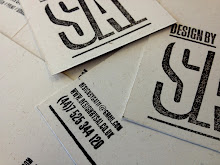
The posters are great. Love the copy and how you let the hand-made paper take center stage and then drove the point home with the simple typography and brilliant message. Nice work.
On the Shade of Green project, I like your thinking and how the package can become something useful afterwards. It shows that you're thinking through the life-cycle. However the images don't really demonstrate the potential of the piece. It would be nice to see the finished pencil holder. It may be better if you show a shot progression - showing the complete package by itself, then the interior with the booklet (but more zoomed out so we can see the contents, and finally the completed pencil holder next to the instructions. That way you the viewer can quickly see what you accomplished without reading and analyzing the pictures. Oh and the photos in the PDF could use some color correcting and white balance adjustment to really showcase your work.
The concept of the Natural History Museum identity is really interesting, however, the detail in the illustrations gets a bit lost on the smaller "n" icons. You might want to tweak those so they work well at smaller and larger sizes—either with finer lines/details, or by simplifying the drawings. I think the strongest versions are the ones that use the illustration as the negative space of the "n", like the shark, and the flamingo?. The triceratops is close as well. It would be great if people see an "n" first and foremost, and then notice that the negative space is actually an animal of some sort. Then with the logotype, I feel like the space to the left of "History" is a bit awkward. I would suggest that you either rework the type to avoid this space, or make some good use of it—maybe by using smaller type to add the name of the city the museum resides in. The use of the illustrations in the collateral is really nice though, nice work.
On the Plan A logo, I'm not really sure what the mark is, but I like it:) and your type is really elegant. During a face to face interview you'd have the opportunity to explain how you arrived at the mark, which will help. As for the animation, I would suggest making the text easier to read by letting the illustrations move around a static text area so that the viewer can read it all. Though I think you were trying to get across the many pledges people were making, my eye was not able to follow both the text and the images, so I often felt like I was missing something important. We don't do motion graphics, though, so that's a bit of an un-educated opinion.
Hope all that was helpful and again, I'm sorry for not getting back to you sooner. Thanks for reaching out to us and feel free to ask any questions to me or to Gage at gage@modernspecies.com.
Take care,
Jennifer Stewart
:: Modern Species LLC
:: a brand design studio
:: 608.467.0162 office
Official Adopter | The Designers Accord
On Jun 21, 2011, at 11:11 AM, Praefa Uennatornwaranggoon wrote:
Dear Modern Species,
I am a Graphic Design student at the Leeds of Art in the UK and attached to this email is a PDF of some of my work. I have a growing interesting in sustainable Graphic Design and I am looking make it a part of my design practice. This is one of the reasons I found your studio so appealing. The other was that I have noticed that you work across a range of discipline from print to branding to web which is something I try to do in all my projects. I know that it would impossible for me to ask to pay a visit at your studio as it is all the way in Wisconsin but I would really appreciate any kind of feedback on my portfolio. I would also be really grateful for any advice on pursuing a sustainable graphic design practice.
P.s I am a little bit in love with you Rollup Logo and packaging :)
Best Regards
Sai Uennatornwaranggoon
Subscribe to:
Posts (Atom)